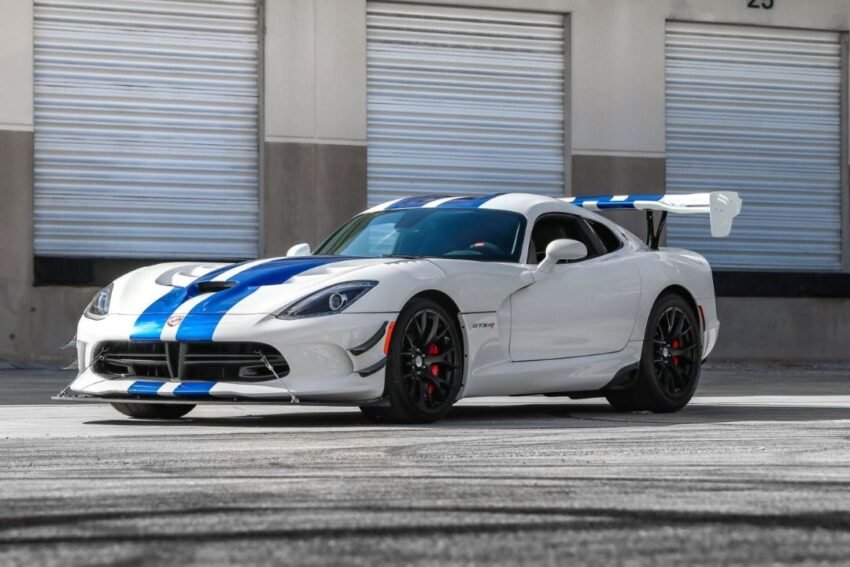
The Dodge Viper car is one of the most recognizable American performance cars ever produced. Known for its enormous V10 engine, aggressive styling, rear-wheel-drive layout, and raw driving character, the Viper became a symbol of old-school American performance. Unlike many modern sports cars that rely heavily on turbocharging, dual-clutch transmissions, and electronic driving aids, the Viper delivered its performance through a large naturally aspirated engine and a traditional manual gearbox.
Although the Dodge Viper is no longer in production, it remains highly desirable among sports-car enthusiasts and collectors. The final production Viper was built in 2017, bringing an end to a remarkable run that helped establish the model as a unique competitor in the high-performance sports-car market. Stellantis records that Viper production ended on August 31, 2017.
So, what makes the Dodge Viper so special? From its massive 8.4-liter V10 to its track-focused ACR version, the Viper combined extreme performance with a distinctly American personality. This guide explores the Dodge Viper performance, specifications, price, features, engine, design, and overall driving experience.
Dodge Viper Overview
The Dodge Viper was developed as a high-performance sports car with a simple philosophy: build something powerful, lightweight, aggressive, and exciting to drive. Over several generations, the Viper evolved considerably, but its core identity remained intact.
The final-generation Viper featured an 8.4-liter naturally aspirated V10 engine producing 645 horsepower and 600 lb-ft of torque. It was paired with a six-speed manual transmission and rear-wheel drive.
Unlike many contemporary performance cars, the Viper did not offer an automatic transmission. The manual gearbox was an important part of its personality, giving drivers direct control over the substantial power produced by the V10 engine.
The final 2017 Viper lineup included different versions designed for street performance and track driving. Among them, the Viper ACR became particularly famous for its extensive aerodynamic package and track-focused hardware.
Dodge Viper Performance
Performance is the primary reason the Dodge Viper developed such a strong following. Its huge naturally aspirated V10 provided tremendous acceleration and a distinctive engine sound.
The final Viper produced 645 horsepower at 6,200 rpm and 600 lb-ft of torque at 5,000 rpm. Power was sent to the rear wheels through a six-speed manual transmission.
The 2017 Dodge Viper ACR tested by Car and Driver accelerated from 0 to 60 mph in 3.3 seconds and completed the quarter-mile in 11.5 seconds at 126 mph. Its estimated top speed was 177 mph.
These figures remain impressive, especially considering that the Viper’s engine used traditional naturally aspirated technology rather than turbocharging.
The Viper’s performance was not only about straight-line acceleration. Its chassis, suspension, brakes, tires, and aerodynamics were developed to make the car capable on demanding roads and racetracks.
Dodge Viper Engine and Powertrain
One of the most important features of the Dodge Viper is its 8.4-liter V10 engine.
The engine is a naturally aspirated, pushrod V10 with aluminum construction and port fuel injection. In the final Viper generation, it delivered 645 horsepower and 600 lb-ft of torque.
The large engine gives the Viper a different personality from smaller turbocharged sports cars. Instead of waiting for turbo boost, the driver gets a direct response from the naturally aspirated powerplant.
The engine is connected to a six-speed manual transmission. This combination gives the Viper a classic sports-car experience that appeals to enthusiasts who enjoy changing gears themselves.
The rear-wheel-drive configuration also makes the car feel distinctly driver-focused. However, the enormous amount of available torque means the Viper demands respect, particularly when driven aggressively.
Dodge Viper ACR: The Track-Focused Version
The Dodge Viper ACR is arguably the most famous performance version of the final-generation Viper.
ACR stands for American Club Racer, and the model was engineered with track performance in mind. Rather than simply increasing engine output, Dodge focused on improving aerodynamics, braking, tires, suspension, and overall cornering ability.
The 2017 Viper ACR retained the 645-horsepower 8.4-liter V10, but its major advantage came from its track-focused equipment. Car and Driver’s tested example featured adjustable suspension, large aerodynamic elements, specialized tires, and a substantial rear wing.
The ACR’s aerodynamic package generated significant downforce, helping keep the car stable and planted at high speeds. Its enormous tires and powerful brakes further enhanced its track capabilities.
In testing, the 2017 Viper ACR achieved 1.15 g of lateral grip on the skidpad and stopped from 70 mph in 134 feet.
These numbers demonstrate why the Viper ACR was much more than a powerful straight-line sports car.
Dodge Viper Specs
The final Dodge Viper’s specifications make it an interesting alternative to modern performance cars.
| Specification | 2017 Dodge Viper |
| Engine | 8.4-liter V10 |
| Horsepower | 645 hp |
| Torque | 600 lb-ft |
| Transmission | 6-speed manual |
| Drivetrain | Rear-wheel drive |
| Seating | 2 |
| Length | 175.7 inches |
| Width | 76.4 inches |
| Height | 49.1 inches |
| Wheelbase | 98.8 inches |
| Fuel Tank | 16 gallons |
| Combined Fuel Economy | 14 mpg |
These specifications are based on the final-generation Viper specifications listed by Car and Driver.
The low height and wide stance contribute to the Viper’s aggressive appearance, while the relatively short wheelbase helps give it a responsive character.
Dodge Viper Price
Because the Dodge Viper is discontinued, there is no current factory MSRP for a new Viper. Buyers interested in the car must generally look at the used and collector-car market.
For reference, the 2017 Dodge Viper SRT Coupe had an MSRP of $92,990, while Car and Driver listed the 2017 Viper range at approximately $92,990 to $123,890 depending on configuration.
The Viper ACR was considerably more expensive. Car and Driver tested a 2017 Viper ACR with a base price of $119,990 and a final tested price of $154,885 after options.
Today’s used-market prices can vary substantially depending on mileage, condition, model year, trim, production number, modifications, maintenance history, and collector interest. Rare editions and low-mileage examples may command significantly higher prices than ordinary examples.
For this reason, anyone researching a Dodge Viper price should check current listings rather than relying solely on the original MSRP.
Top Dodge Viper Features
1. Massive Naturally Aspirated V10
The 8.4-liter V10 is the heart of the final Viper. Its 645 horsepower and 600 lb-ft of torque provide exceptional performance without turbochargers.
2. Six-Speed Manual Transmission
The manual transmission gives drivers direct control over the Viper’s power. This is one of the features that makes the car attractive to enthusiasts looking for a traditional performance-car experience.
3. Rear-Wheel Drive
Rear-wheel drive contributes to the Viper’s engaging handling characteristics and allows experienced drivers to make full use of its powerful engine.
4. Aggressive Exterior Design
The Viper’s long hood, low roofline, wide body, large air openings, and muscular proportions give it an unmistakable appearance. Its design was created to communicate performance rather than luxury.
5. Track-Focused ACR Model
The Viper ACR took the standard Viper concept much further with advanced aerodynamics, specialized tires, performance suspension, and powerful braking hardware.
6. Lightweight Performance Philosophy
While the Viper was not an ultra-light sports car by modern standards, Dodge emphasized performance-oriented construction and a relatively straightforward mechanical layout.
7. Driver-Focused Interior
The Viper’s interior was designed around the driver rather than maximum luxury. It offered the essential equipment expected in a modern sports car while retaining the model’s performance-first identity.
Dodge Viper Design and Styling
The Dodge Viper has always been easy to recognize. Its proportions are dramatically different from those of ordinary passenger cars.
The long hood accommodates the large V10 engine, while the cabin sits relatively far back. The low roof and wide body create a purposeful stance.
The final-generation Viper also used composite and aluminum body components, while its chassis and suspension were designed around high-performance driving. The 2017 Viper featured four-wheel disc brakes with ABS, sport-tuned suspension, and a mechanical limited-slip differential.
The result is a car that looks fast even when it is parked.
Driving Experience
Driving a Dodge Viper is very different from driving a typical modern sports car.
Modern performance vehicles often use sophisticated electronic systems to make enormous power easier to manage. The Viper, especially in its earlier forms, developed a reputation for being demanding and rewarding in equal measure.
The final-generation car became more sophisticated and easier to control than early Vipers, but it still retained a strong mechanical character.
The steering, manual transmission, powerful brakes, large V10, and rear-wheel-drive layout all contribute to an immersive driving experience.
For enthusiasts, this is one of the Viper’s greatest strengths. It feels like a machine that requires the driver to participate rather than simply select a driving mode and let electronics handle everything.
Fuel Economy and Practicality
Fuel economy is not the Dodge Viper’s strongest area. The 2017 model was rated at approximately 12 mpg city and 19 mpg highway, with a combined rating of 14 mpg.
The car also seats only two people, so it is not designed for family transportation.
However, sports-car buyers generally choose the Viper for performance, character, exclusivity, and driving enjoyment rather than practicality.
Its 16-gallon fuel tank and limited cargo capacity also make it less practical than a conventional vehicle. Nevertheless, these compromises are part of the Viper’s purpose: it was created primarily as a high-performance sports car.
Why Was the Dodge Viper Discontinued?
The Dodge Viper’s production officially ended on August 31, 2017.
The end of production marked the conclusion of one of America’s most distinctive sports-car stories. The Viper had survived for multiple generations, but changing market conditions, production considerations, and the economics of building a low-volume performance car made its continuation difficult.
Even after production ended, the Viper continued to attract attention because of its unusual combination of a huge naturally aspirated V10, manual transmission, rear-wheel drive, and aggressive design.
Is the Dodge Viper Still Worth Buying?
For the right enthusiast, a Dodge Viper can still be a highly desirable sports car.
The biggest reasons to consider one include its unique V10 engine, manual transmission, distinctive styling, limited production, and collector appeal.
However, potential buyers should carefully inspect any used Viper before purchasing. Maintenance records, accident history, modifications, tire condition, brakes, suspension components, and overall mechanical condition can have a major impact on ownership costs.
Buyers should also remember that the Viper is an older performance car rather than a modern vehicle with the latest driver-assistance technology, infotainment systems, and fuel-efficient powertrains.
Dodge Viper vs. Modern Sports Cars
The Viper’s greatest advantage today is its character.
Modern sports cars can be quicker, more technologically advanced, and easier to drive quickly. However, relatively few cars offer the combination of a large naturally aspirated V10, manual transmission, rear-wheel drive, and an aggressive American design.
The Viper therefore occupies a special place in automotive history.
Its appeal is not simply about acceleration numbers. It is about the experience of operating a powerful mechanical machine with a direct connection between driver, engine, transmission, and road.
Final Verdict
The Dodge Viper car remains one of the most iconic American performance cars ever made. Its enormous 8.4-liter V10, 645 horsepower, 600 lb-ft of torque, six-speed manual transmission, and rear-wheel-drive layout give it a personality that is difficult to replicate.
The final 2017 model represented the peak of the Viper’s development, while the Viper ACR demonstrated how far the platform could be pushed on a racetrack. With its aggressive aerodynamics, specialized tires, performance suspension, and powerful brakes, the ACR became one of the most capable track-focused American sports cars of its era.
Although the Dodge Viper is no longer produced, its reputation remains strong. For collectors and driving enthusiasts, it represents a different era of performance—one centered on a massive naturally aspirated engine, a manual transmission, rear-wheel drive, and an unapologetically aggressive design.
If you are researching Dodge Viper specs, price, performance, engine, features, or buying options, the Viper remains an important name in automotive history and a fascinating choice in the collector-car market.