
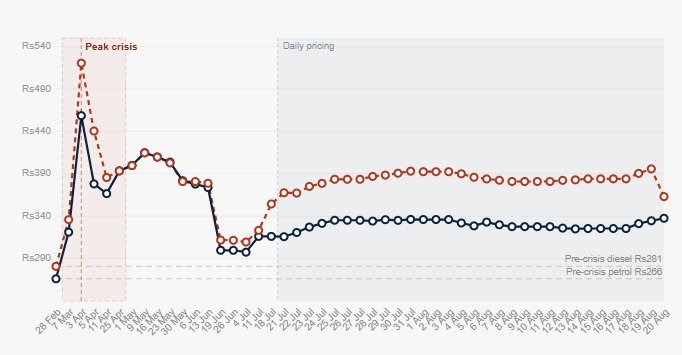
The government has announced a major change in petroleum prices, bringing significant relief to diesel consumers while slightly increasing the cost of petrol. Under the latest revision, the price of High-Speed Diesel (HSD) has been reduced by Rs32.63 per litre, while petrol has become Rs2.97 per litre more expensive.
The revised prices came into effect from Thursday, August 20, following what the government described as successful discussions with oil refineries. After the adjustment, petrol will now be sold at Rs337.51 per litre, while the new price of HSD stands at Rs363.06 per litre.
The latest move comes at a time when international oil markets have remained highly uncertain because of tensions and conflicts in the Middle East. Global oil prices have experienced sharp movements in recent months, creating pressure on domestic fuel prices and forcing governments to regularly review petroleum rates.
Despite the reduction in diesel prices, the government continues to collect a substantial amount in taxes and duties on petroleum products. According to the latest figures, taxes and duties amount to around Rs114 per litre on petrol and Rs100 per litre on diesel. This means that a significant portion of the price paid by consumers continues to go toward government revenue.
Diesel Sees a Major Reduction
The Rs32.63 reduction in diesel prices is particularly important because HSD is widely used by the transport, agriculture and industrial sectors. Diesel is also an important fuel for power generation and commercial vehicles, meaning changes in its price can affect the cost of transporting goods and operating businesses.
The latest reduction brings some relief after diesel prices reached extremely high levels earlier this year. The price of HSD had climbed to Rs520.35 per litre on April 3. Before the increase began, diesel was being sold at around Rs281 per litre.
The sharp rise was linked to increasing international oil prices following the outbreak of conflict between the United States and Iran on February 28. The resulting uncertainty raised concerns about global oil supplies and pushed energy prices higher.
Although the latest reduction does not completely erase the earlier increase, it represents a significant change for consumers and businesses that rely heavily on diesel.
Petrol Price Moves Higher
While diesel users are benefiting from the reduction, petrol consumers are facing a small increase. Petrol prices have been raised by Rs2.97 per litre, taking the new selling price to Rs337.51.
Petrol prices had also experienced a substantial increase earlier in the year. The price reached Rs458.41 per litre on April 3 after rising from approximately Rs266 during the first week of March.
For millions of motorists, particularly motorcycle and small-car owners, petrol prices have a direct impact on household budgets. Rickshaw drivers and other small transport operators are also sensitive to fuel price changes because fuel represents a major part of their daily operating expenses.
Even a small increase in petrol prices can therefore have a wider effect, especially for lower- and middle-income households that depend on private or informal transport.
Government Moves Toward More Frequent Price Reviews
The government has been closely monitoring developments in international oil markets. Petroleum Minister Ali Pervaiz Malik had previously stated that fuel prices could be adjusted on a daily basis because of continuing fluctuations in international markets caused by geopolitical tensions.
Previously, the government announced petroleum price changes on a weekly basis while also considering fuel conservation measures. These steps were introduced amid concerns that conflicts in the Middle East could disrupt international oil supplies.
The cabinet and prime minister have also decided to assign the responsibility of determining fuel prices on a daily basis to the Oil and Gas Regulatory Authority (OGRA). The aim is to ensure that domestic petroleum prices reflect changing international market conditions more quickly.
A more frequent pricing mechanism could allow consumers to benefit sooner when global oil prices decline. However, it could also mean that motorists and businesses face more frequent price changes when international markets become volatile.
Impact on Transport and the Economy
Fuel prices have a much wider impact than simply changing the amount motorists pay at filling stations. Diesel is heavily used in the transport sector, so a significant reduction could eventually help lower freight and transportation costs.
If transport operators pass some of the savings on to consumers, the lower diesel price could reduce the cost of moving food, raw materials and other goods across the country. It may also provide some relief to businesses facing high operating costs.
Petrol, meanwhile, remains particularly important for private vehicles, motorcycles, small cars and rickshaws. The increase of Rs2.97 per litre may appear modest, but frequent fuel purchases can make even small price changes noticeable for daily commuters.
Petroleum Revenue Remains Important
Petrol and HSD are also major sources of government revenue because of their high consumption volumes. Monthly sales of petrol and diesel are estimated at around 700,000 to 800,000 tonnes, while the monthly requirement for kerosene is only around 10,000 tonnes.
This difference highlights the importance of petrol and diesel to both the economy and government finances. Any major change in their prices can therefore affect consumers, businesses, transportation costs and public revenue at the same time.
The latest adjustment offers a mixed picture for consumers. Diesel users have received a substantial price cut, while petrol users will have to pay slightly more. With international oil markets still influenced by geopolitical developments, further changes in domestic fuel prices remain possible.
For now, the sharp reduction in diesel prices provides much-needed relief to transport and industrial users, while the petrol increase adds another cost for everyday motorists. The coming weeks will show whether international oil prices remain stable or create the need for another adjustment in the domestic petroleum market.
