
Further attacks were made by the US military forces on Iran on Tuesday, leading to an attack by the Iranians on Jordan, Bahrain, and Kuwait despite warnings by President Donald Trump that Iran would “hit much harder” should it retaliate.
The recent exchange of attacks between the two sides is in continuation of their attacks that started late last night into the early morning of Monday. The exchanges could result in a rekindling of the destructive conflict following several weeks of peace in the military front.
Following the fresh attacks on the Iranian side, Trump has cautioned Iran that its response will attract further military action, stating that it would “be hit again at a much harder and higher level”.
“In the wings is the mother of all attacks, which once it is over, very little will be left of the Islamic Republic of Iran!” Trump wrote in Truth Social on Tuesday.
Nevertheless, Iran promised “crushing retaliation” by using ballistic missiles against Jordan, and drones against Bahrain and Kuwait, saying that its target was the US military equipment.
Tehran reported that debris from one of the US attacks fell on a wedding in the southern part of the country, killing at least four people, including a child. CNN has contacted US Central Command (CENTCOM) for a response to Iran’s allegation.
The US attacks were in retaliation for attempts made by Iran to attack “commercial shipping in the Strait of Hormuz and American troops stationed in the area,” according to X post from CENTCOM.
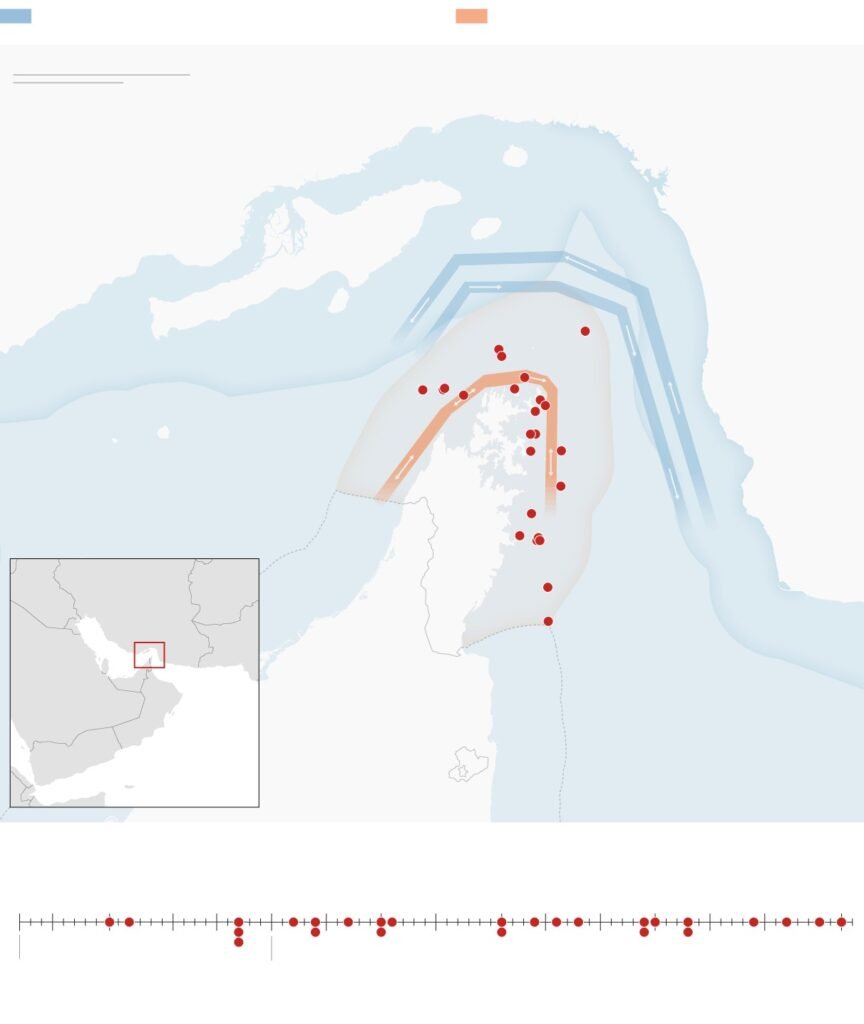
Because of the attacks conducted by the US on Sunday, two tankers have been hit by missiles, according to the maritime intelligence company Marisks and the United Kingdom Maritime Trade Operations (UKMTO). The US and Iran are engaged in a prolonged conflict for control of the passage, which is essential for global oil supply.
According to CENTCOM, the strikes made on Tuesday hit “air defense sites, radar systems, maritime assets and facilities, mine laying capabilities, and communication sites” of Iran’s Islamic Revolutionary Guard Corps. The strikes were launched at 12 p.m. ET and lasted more than six hours until it was announced that they were over.
Despite Trump warning about his intention to shift from a military strategy to an economic one in advance, the escalation of the armed conflict took place.
Iran strikes ships using ‘unauthorized’ route through Strait of Hormuz
Vessels have faced at least 26 attacks since June 17, the same day when the Iran-US agreement came about regarding letting the commercial ships sail through the strait. Out of the five attacks, four occurred before President Donald Trump declared that the ceasefire was no longer in effect on July 10.
“I’m not trying to pressure Iran to the negotiating table,” Trump tweeted on Truth Social on Tuesday night in retaliation to Iran’s attacks. “I prefer our current posture, which is one of having almost total control of the Hormuz Strait and their economy totally collapsing.”
What was targeted on Tuesday?
The Jordanian authorities stated that they had managed to intercept 10 missiles sent by Iran, while three other missiles were shot down in deserts away from any densely populated area. No casualties were recorded, the Jordan military sources announced.
The Kuwaiti and Bahraini air defense systems were also activated in order to intercept Iranian drones, as announced by their officials. Also, Iran announced a missile and drone attack on Erbil situated in Iraqi Kurdistan.
US strikes, for their part, hit several targets in Iran.
According to the state-affiliated IRNA news agency, seven people died as a result of the strikes in the central province of Khuzestan which is adjacent to Iraq, an official of the province was quoted as saying.
Also, the port cities of Chabahar and Konarak located in the Gulf of Oman and housing important infrastructure were targeted. Moreover, explosions were reported east of Bandar Abbas and the Qeshm Island near the Strait of Hormuz.
The state media Press TV reported that the attacks also targeted Jiroft Airport, which is situated in southeast Iran, as well as a fish meal factory on Qeshm Island in the strait.
In addition, an explosion was reported to occur in Asaluyeh, a gas and petrochemicals hub located in south Iran, according to reports by Iran’s semi-official news agency Fars.
Shrapnel falls on wedding party
According to Press TV, Iranian officials have reported that several people have died, including a four-year-old boy, and that at least 68 other people have been injured as a result of the shrapnel falling on a building where a wedding reception was being held in Kouhestak, a village located along the coast of Sirik county, in southern Iran.
In footage obtained from the semi-official Tasnim news agency, claiming to portray the scene after the US strike, there is visible smoke in the sky, rising above the rubble on the ground. Around the area, people could be heard shouting. CNN has geolocated the images to be from a residential area of Kouhestak.
Moreover, a communications tower in Kouhestak was significantly damaged as well. This tower was approximately 135 meters (442 feet) away from the building where the wedding reception was held.
A total of 19 of the wounded individuals were children under the age of ten, including seven boys and twelve girls, as reported by the state-linked ISNA.
Esmaeil Baqaei, spokesperson for the Iranian Foreign Ministry, condemned this act as a part of “catalogue of atrocities” committed by the US.
The strike received extensive coverage in all of Iran’s state news media outlets, which led to uproar on Iranian social media networks as well as the release of Lego-inspired animated video, the type that has become the staple of Iran’s propaganda during the war.
It is not possible for CNN to confirm the information regarding the purported strike independently.
Kouhestak is located just 37 kilometers (22 miles) away from the city of Minab, where the US struck a local school in February, killing at least 168 children and 14 teachers, according to Iran.
Strait of Hormuz will be ‘worthless piece of water’
The return of the violence occurs amid an arm-wrestling battle between the US and Iran regarding the Strait of Hormuz, which Tehran considers its domain but the US insists is international territory.
The waterway has been a bottleneck for the world’s oil supplies since the outbreak of the war, but of late there has been an increase in oil shipments via the strait.
It is alleged that the US attacked Iran on Sunday in retaliation for the latter’s attempts to lay additional sea mines in the strait using rocket launchers. Tehran reacted to the attacks by hitting what it considered to be US military targets in the Middle East.
Speaking to Fox News on Tuesday, Trump stated that the US warned its Gulf allies of its upcoming strikes and denounced the leadership of Iran. “I do not think that any agreement with them is worth the paper it is written on,” said the president, adding: “They don’t stop: they are crazy and stupid.”
Trump also revealed that the US attacked radar systems that Tehran tried to reconstruct. “They tried to reconstruct their radar because they can’t see anything,” he said. “We waited till it was almost built and then we hit it.”
The Trump administration has been consistently dismissing concerns about Iran’s long-term control of the strait.
“Within two years, the Strait of Hormuz is going to become a valueless sea; the oil is going through the pipelines on land,” US Treasury Secretary Scott Bessent said in an interview on Tuesday with Larry Kudlow on the sidelines of the G20 summit. The statements were made in connection with the Gulf states’ plans to develop infrastructure independent of the strait.
The US Treasury Department’s initiative to isolate the Iranian economy from the rest of the world in order to pressure Tehran into signing a deal is described by Bessent as his work to “ensure that they want to have a deal.”
“The world is tired of this pariah state or rogue state and is willing to make this a pariah,” Bessent said. “We’re going to economically strangle this regime.”
According to him, the Treasury Department, which first targeted a bank in Dubai that has links with Iran, will also target two more banks within the next couple of weeks.
