KARL MAYER Supplies Warp Preparation Technology Behind the AI Boom
OBERTSHAUSEN, Germany, August 9, 2026: The rapid expansion of artificial intelligence is creating demand not only for advanced computing systems but also for the specialized materials and manufacturing technologies required to build them. German textile machinery manufacturer KARL MAYER is benefiting from this trend through its warp preparation technology used in the production of glass fabrics for copper-clad laminates.
Copper-clad laminates, or CCLs, form the base material for printed circuit boards and are a critical component of the hardware infrastructure supporting AI systems. These laminates commonly use woven glass fabric as reinforcement, linking the textile industry directly to the rapidly expanding electronics and data-center markets.
According to Enzo Paoli, President of KARL MAYER’s Warp Preparation Business Unit, global production of glass fabric currently stands at around four billion meters annually. The company expects another two billion meters of production to be added by 2028, highlighting the scale of the opportunity created by growing demand for advanced electronics.
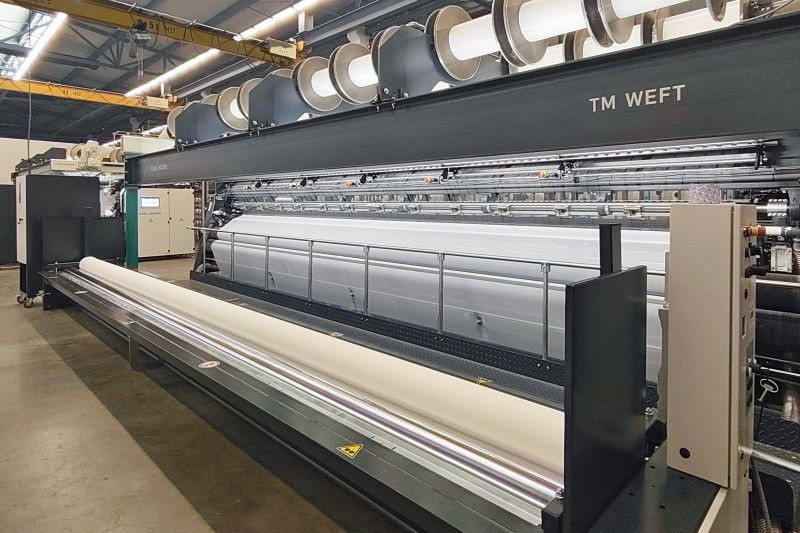
KARL MAYER has established a strong position in this market with its FILSIZE-G sizing machine and AM-G assembling machine. The systems are designed to provide reliable processing, high productivity and consistent warp quality, even when manufacturers frequently change products.
The company’s involvement in electronic glass production dates back nearly two decades. Its first deliveries in this segment were made in 2007 to customers in China and Taiwan. Continued development of its warp preparation technology helped establish the equipment as an industry standard, with a major milestone reached in 2020 when KARL MAYER sold its 100th machine for electronic glass applications in China.
AI increases demand for advanced glass fabrics
The growing complexity of AI servers is placing new demands on printed circuit board manufacturing. Modern AI systems require increasingly sophisticated PCBs with substantially more layers than those used in conventional electronic products.
Standard electronics typically use CCLs with around six layers, while electric vehicles and mobile phones can require approximately 12 layers. AI data centers are increasingly using PCBs with more than 24 layers, significantly increasing the requirement for high-quality glass fiber fabrics.
These increasingly complex materials also make the manufacturing process more demanding. Precise control of yarn tension during warp preparation is particularly important because even small variations can produce differences in fabric density.
Such inconsistencies can affect the performance of high-frequency signals traveling through electronic systems. The resulting signal propagation differences are commonly associated with the fiber-weave effect, also known as intra-pair skew.
KARL MAYER’s warp preparation systems are designed to address these challenges by maintaining precise and consistent yarn processing. Reliable tension control and uniform warp quality are becoming increasingly important as manufacturers seek to meet the stringent requirements of next-generation electronic applications.
Textile machinery becomes part of AI infrastructure
The connection between textile machinery and artificial intelligence illustrates the increasingly interconnected nature of modern manufacturing. While AI development is commonly associated with semiconductors, processors, software and data centers, its physical infrastructure depends on a broad network of materials and production technologies.
High-performance servers require advanced printed circuit boards, while those PCBs depend on copper-clad laminates reinforced with specialized glass fabrics. Producing those fabrics, in turn, requires highly controlled textile processes.
KARL MAYER’s long experience in glass-fabric warp preparation therefore places the company in a position to benefit from the continued expansion of AI infrastructure worldwide.
As investment in AI data centers accelerates and electronic systems become more sophisticated, demand for high-performance materials is expected to remain strong. For manufacturers of glass fabrics, maintaining precise production standards will be essential to meeting the increasingly demanding requirements of advanced electronics.
KARL MAYER’s experience in warp preparation, combined with its established customer base and specialized machinery, gives the company an important role in this expanding supply chain.
The development demonstrates how technologies originating in traditional textile manufacturing are becoming increasingly important to the digital economy. As AI continues to reshape industries, the machinery used to produce the materials behind its hardware is becoming an increasingly significant part of the technology ecosystem.