
OBERTHAUSEN, Germany, August 9, 2026 – The emergence of artificial intelligence is impacting not only software, processing capabilities, and data centers. There is an elaborate industrial supply chain that lies behind the development of artificial intelligence around the world, and this supply chain relies on unique materials, electronics, and manufacturing technologies.
Among companies that benefit from the wider trend is a German-based manufacturer of textile machinery, KARL MAYER, which provides warp preparation technology used for making glass fabrics for copper-clad laminates (CCLs). This material is very important in the production of printed circuit boards (PCBs), which, in their turn, become the core elements of servers and networking equipment, used to create AI infrastructure.
The development highlights an often-overlooked connection between the traditional textile machinery sector and the fast-growing digital economy.
Copper-Clad Laminates: A Foundation of Modern Electronics
Copper clad laminate is a key material that is used in the production of printed circuit boards. Typically, CCLs comprise a reinforcing fiber that can be woven glass fabric, resin and copper.
Woven glass fabric serves as a strengthening component that assists in achieving the physical and electrical requirements of today’s electronic applications. Since PCBs are used in all advanced electronic systems, the demand for high-quality copper clad laminates is directly related to developments in industries like AI, electric cars, telecommunication and computing.
The development of AI hardware is especially noteworthy. AI systems and data centers need complex circuit boards that can cope with the high-speed and high-volume data processes.
This will result in increased pressure being exerted on the glass fabric used in the laminate that forms the basis of the circuit board.
According to Enzo Paoli, President of the Warp Preparation Business Division at KARL MAYER, “Worldwide glass fabric production is presently estimated to amount to some four billion meters per year, and KARL MAYER expects to produce a further two billion meters by 2028.”
AI Hardware Requires More Sophisticated Materials
The fast growth of AI computer processing power compels electronics companies to develop ever more sophisticated printed circuit boards.
Common electronic devices may include CCLs with about six layers, but electronic vehicles and smartphones may need up to 12 layers. In contrast, the systems for AI data centers now tend to employ PCBs with more than 24 layers.
With the increase in the number of layers, the material specifications to produce those printed circuit boards grow as well.
Glass fabric quality is especially crucial since any non-uniformities in manufacturing the fabric may influence the properties of the final circuit board. One of the major issues is ensuring the uniformity of yarn tension in the process of preparing the warp.
Even small changes in tension can create differences in density of the fabric.
In hi-tech electronic uses, these differences can affect the propagation of high frequency signals across the board.
This problem can be manifested in a phenomenon called the fiber weave effect, or intra-pair skew. It arises due to the interaction between the signal paths and the structure of the woven glass fabric.
Thus, for the more advanced AI hardware, there is a need for materials that are made using consistent specifications.
KARL MAYER’s Role in Glass-Fabric Production
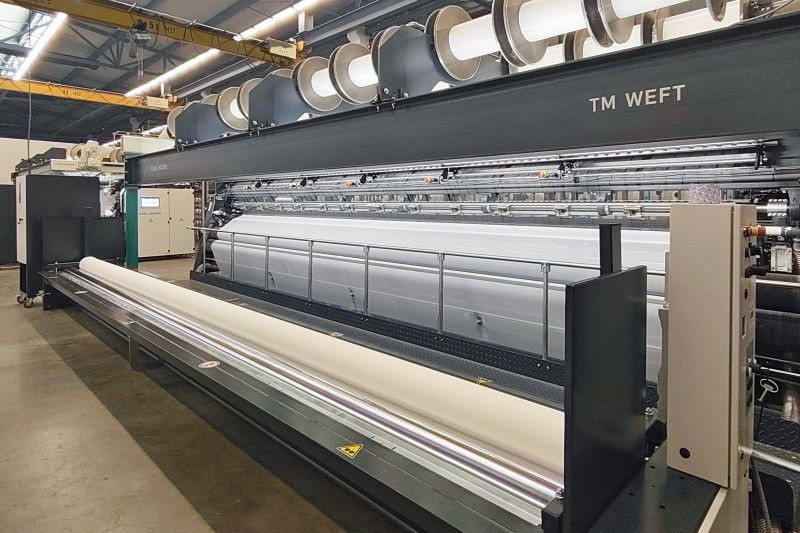
The KARL MAYER company has created special machinery that is able to cope with tough demands of electronic glass manufacturing.
FILSIZE-G and AM-G machines of the firm have been specially designed for the efficient processing, high productivity and good warp quality. This is very helpful in the industry where firms have to change the products often while meeting high standards of quality.
Warping is one of the steps of textile manufacturing process. It is the stage at which preparation of yarns before weaving takes place, and the elements like yarn tension and alignment affect the quality of textiles.
When it comes to the production of electronic glass fabrics, accuracy is critical because the end product will not just be used as any other fabric but will be incorporated into an advanced electronic device where minor deviations will affect its functionality.
At the same time, KARL MAYER has found itself in a key position of the electronics value chain when it comes to producing glass fabrics suitable for PCBs.
Nearly Two Decades of Experience
INNOVATION WITH ELECTRONIC GLASS HAS NOT BEEN RECENTLY CREATED WITH THE CURRENT REVOLUTION IN ARTIFICIAL INTELLIGENCE.
The first orders that KARL MAYER delivered into this category were as early as 2007, and the customers were in China and Taiwan. After that, the company has been developing and enhancing its warp preparation technology capabilities in this business line.
Another milestone took place in 2020 when KARL MAYER delivered the 100th machine for the purpose of manufacturing electronic glass in China.
It is safe to say that the company has many years of experience in such a market, which gains even more strength now thanks to investments into the artificial intelligence infrastructure.
As the infrastructure of artificial intelligence is growing rapidly, there is a growing need for high-performance computers all over the world. As the centers of data are expanding and server technology grows, the entire electronics supply chain is facing the challenge of increasing production under strict quality control requirements.
It creates a great opportunity for glass fabricators and machines to manufacture them.
From Textile Manufacturing to AI Infrastructure
It may seem strange at first glance that the interaction between textile machinery and artificial intelligence can have some common ground.
AI is most often related to chips, software, cloud solutions and data centers, not weaving machines or textile production lines.
But modern tech supply chains are very intertwined.
The operation of an AI data center requires powerful servers. Powerful servers require printed circuit boards. Printed circuit boards require copper-clad laminates. Copper-clad laminates are produced using woven glass fabrics. The production of such fabrics requires special processes and machinery.
Thus, even companies lower down the manufacturing chain can get some profit from investments in AI infrastructure.
The case of KARL MAYER shows how technology designed for textile industry can become necessary for the tech industry. Though the machinery itself does not operate in the realm of computing or artificial intelligence, it still produces components which allow AI hardware to function.
Rising Demand Could Reshape the Market
The anticipated expansion of about two billion meters of glass fabric production by 2028 indicates the scope of future demand.
In light of the application of artificial intelligence in sectors like cloud computing, enterprise software, autonomous systems, research, and communication, there is high probability that future electronics manufacturing will be driven by demand for computing infrastructure.
However, artificial intelligence is becoming more complicated. Advanced systems will need circuit boards with increased component capacity and electrical performance.
Therefore, there will be an increase in demand for manufacturing precision throughout the supply chain.
For producers of glass fabric, this will mean that besides increasing production capabilities, they must acquire machinery capable of offering consistent fabric quality. Yarn handling, tension control, and warp preparation equipment will increasingly become relevant.
A Broader Industrial Impact of AI
The story of KARL MAYER and electronic glass production offers a broader lesson about the
economic benefits associated with artificial intelligence.
Investments in AI technology are not restricted only to technology firms. The development of AI could affect the producers of semiconductor products, cooling devices, power devices, networking products, building products, and industrial machinery.
Here, the connection starts at AI server and ends at textile machines required for spinning glass fabric yarns.
This connection shows the intricacies involved in today’s global technology environment. High-performance electronics require a complex combination of materials, products, and manufacturing process steps that get far less recognition than the end product itself.
With growing applications of AI, such supporting industries are getting more and more significant.
For KARL MAYER, years of expertise in producing warp fabric for electronic glass make the firm a candidate for involvement in this expanding industry. The combination of the firm’s FILSIZE-G and AM-G technology solutions and reputation among manufacturers of glass fabric provides an excellent base from which further growth is possible with rising demands for advanced electronics.
In summary, the development of AI has created an expanding opportunity space outside of the realms of software and semiconductors. Increasing demand for advanced printed circuit boards means that there is also increasing demand for high-quality copper-clad laminates and, therefore, increasing demand for precision glass fabric.
This represents a good example of how traditional industrial technologies are becoming part of the infrastructure behind the digital future. With the increasing capabilities of AI systems, perhaps the machinery involved in the production of their core components will be equally as important as the machines themselves.
