
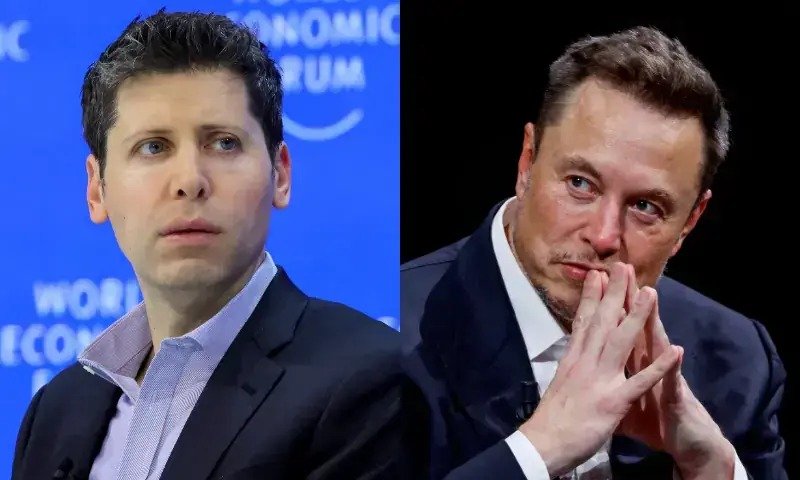
OpenAI said on Friday that it plans to stop providing AI models to Cursor, the coding-tool company now owned by Elon Musk’s SpaceX, marking a further escalation in the bitter rivalry between OpenAI CEO Sam Altman and Musk.
Both Musk and Altman have been at loggerheads for quite some time now, with their disagreement coming to a head earlier this year in court after Musk sued OpenAI over his $150 billion case. According to Musk’s attorney, during the hearing, Musk and others claimed that Altman was lying, while OpenAI maintained that Musk wanted to control the organization.
“We are making this decision because we can’t be certain that SpaceX will utilize our tech according to our terms of service based on the violations of contracts by Elon Musk’s firms,” wrote OpenAI in a blog post.
“I couldn’t care less,” replied Musk via X on Saturday morning.
Musk called out Altman and Greg Brockman, who is the president of OpenAI, as “untrustworthy,” while stating that he maintains that they “stole an open source nonprofit.”
Musk, who is the world’s wealthiest man, had filed a lawsuit against OpenAI and Altman for “stealing a charity” after reneging on the nonprofit mission of the organization and enriching himself.
But Michael Truell, one of the founders of Cursor and who works at SpaceX, stated on his Twitter account that they were in talks with the OpenAI team regarding this problem.
Just a few hours after OpenAI’s announcement, competitor Anthropic, which has its own partnership with SpaceX, announced plans to increase computing for Claude models in Cursor, as shared by Tom Brown, one of the co-founders of Anthropic.
In its blog post, OpenAI said that X, previously called Twitter and now owned by SpaceX, violated the terms of its contract with OpenAI, following Musk’s acquisition of the platform.
“To work with a major partner like SpaceX, we need special contracts to ensure compliance with our terms of service and that the integration is safe at scale,” the AI company also added.
The ChatGPT company offered a shutoff date of November 12, 2026, noting that its contract with Cursor offered it a limited time period to terminate the contract “after a change of control.”
SpaceX made an agreement to acquire Anysphere, the startup behind Cursor, for $60 billion in an all-stock deal back in June and recently closed the acquisition.
OpenAI points to contractual concerns
According to OpenAI, such collaboration with large companies like SpaceX usually implies special customized agreements to guarantee compliance and ensure the appropriate safety standards.
Thus, OpenAI stated that it decided to stop cooperation with the company because it could not be sure that SpaceX would apply the technology offered by OpenAI in accordance with the conditions.
In addition, OpenAI drew upon its experience with other firms under the control of Elon Musk. Specifically, it talked about violations of contractual obligations that occurred when Musk took possession of X, formerly known as Twitter.
It is the reflection of a more general problem that confronts AI companies while incorporating their models into products of larger technology companies. AI companies compete in the development of better models but they are also concerned about the integration, deployment and access to those models.
It is the case with OpenAI which has to ensure how coding assistants can apply powerful AI models that require a lot of computational power, access to the source code and automatic development workflow.
Cursor has turned into one of the most well-known platforms for applying AI for coding. It allows the development and modification of software with the help of artificial intelligence. This platform has been using AI models of a number of top AI providers.
Legal battle added to the rivalry
The recent rift is caused by another legal battle which has recently erupted between Musk and OpenAI.
According to Musk, the two were guilty of reneging on the initial nonprofit mission of OpenAI and placing their business motives above the noble values upon which the corporation was established.
However, Musk’s allegations were brushed aside and Altman countered that he only wanted to have more influence on the corporation.
Ultimately, this matter was taken to court and an open trial took place in which several high-profile individuals such as Musk and Altman testified on behalf of their respective parties.
The lawyers for Musk painted Altman as unreliable in their arguments, while the defendants suggested that his claims were partly caused by the desire to control the corporation.
The case was settled in favor of the defense and a federal jury ruled that it had been filed past its deadline. Regardless of the verdict, Musk has not stopped criticizing OpenAI.
Therefore, the feud has gone beyond court and entered the sphere of technological competition.
SpaceX acquisition changes Cursor’s position
The first and foremost cause of OpenAI’s action has been SpaceX’s recent acquisition of Anysphere which is the startup that created Cursor.
The deal was announced in June and was estimated at $60 billion through the exchange of stocks only. The acquisition has happened not long ago.
Firstly, SpaceX’s acquisition of Anysphere was remarkable due to its scale but mostly because it meant the addition of a rapidly growing company of AI software to Musk’s technological portfolio.
Cursor has been gaining popularity among software engineers with the rise of applications of AI tools to coding. These applications allow software engineers to code, debug, modify their programs, etc., and thus save time on performing many routine operations.
In this regard, SpaceX gains access to one more link in rapidly evolving ecosystem of AI technologies.
Spacex already has huge companies of technology and infrastructure, while Musk himself constantly speaks of the role of AI and supercomputing.
It is interesting that SpaceX has acquired the company which works using models that are developed by competitors of Musk’s AI projects.
This situation was made even more complicated with the decision of OpenAI to stop providing models to Cursor.
Cursor seeks a solution
Notwithstanding the announcement, it does not necessarily mean that there will be a permanent divorce of the parties as a consequence of the dispute.
As reported by Michael Truell, one of the founders of Cursor, who currently serves as an executive at SpaceX, the company is in talks with OpenAI regarding the problem.
In other words, both parties still have an intention to find a way to work together despite certain changes.
It may include certain modifications to their contractual obligations and additional limitations on using OpenAI models within Cursor.
Nevertheless, the fact that the company chose to use its rights means that, according to the company, the change in ownership is significant enough to activate certain clauses of the agreement.
This case demonstrates the importance of the changes in ownership for technology agreements. In other words, a company may have some kind of a contract with an AI provider, however, after the acquisition by a different company, it will become possible to activate certain clauses of the agreement.
A larger battle over AI partnerships
This conflict between OpenAI and SpaceX-owned Cursor is just a small part of the broader rivalry around AI infrastructure and software.
Major players in the AI market are competing for ever more powerful models and trying to gain access to computing power necessary to run these models.
On top of that, the AI models themselves become components of products offered by other firms. This results in rather complex relations in which firms are both customers, business partners and rivals.
Cursor is an excellent illustration of this problem.
The code writing tool relies on powerful AI models, while OpenAI can use its technology by developers in third-party software. Once the ownership of the firm is changed, the situation may turn into something more complex.
The fact of acquisition by SpaceX has significantly altered the context of the rivalry around Cursor.
For OpenAI, it was not only about keeping Cursor as a client. It was also about the possibility that technology developed by it would be used by a firm owned by one of its biggest critics and AI rival.
What the decision means for Cursor users
As far as Cursor users are concerned, the first question they might be asking themselves is what comes next after the deadline of November 12.
It is worth noting that the platform is not limited only to one particular AI company, and thus Anthropic can try to enhance its support in order to reduce the influence of this decision by OpenAI.
However, some of the customers might be affected differently depending on the models they use.
It is especially relevant for the AI coding tools, as the developers compare various AI models depending on how well they understand the code base, follow instructions and write the appropriate software.
Being flexible about working with various models is one of the main features of Cursor, and this aspect might be more important than ever before.
Musk and Altman’s rivalry shows no sign of ending
The newest controversy shows us that the ongoing struggle between Musk and Altman continues to be an important element of the tech sector.
Their arguments emerged from the difference in their visions concerning OpenAI and grew into a contest of research in AI, corporate strategies, legal battles and business partnerships.
At the moment, Musk runs or controls several important tech companies, whereas Altman is at the head of the one of the biggest and most powerful companies developing artificial intelligence.
Thus, the companies of both entrepreneurs compete for developers, computing power, clients and strategic influence on the further development of artificial intelligence.
Therefore, OpenAI’s decision in regard to Cursor cannot be treated as an isolated contract dispute.
It is yet another example of the increasingly competitive climate of the AI field, where relationships between companies can quickly change after their acquisitions and where alliances between technology companies have huge strategic importance.
For Cursor, the task will be not only to keep their service running, but also to manage their relations with various providers of artificial intelligence services.
For OpenAI, this decision strengthens the company’s readiness to limit access to its technology in case there are significant risks.
In addition, for Musk, this step becomes a new episode in his ongoing conflict with the leadership of OpenAI.
As the deadline of November arrives, all the attention will be focused on whether the companies can find a compromise and make a deal or whether the AI models of OpenAI will eventually leave Cursor.
This event will have broader consequences in the field of AI coding, where developers rely more and more on AI technologies.
