
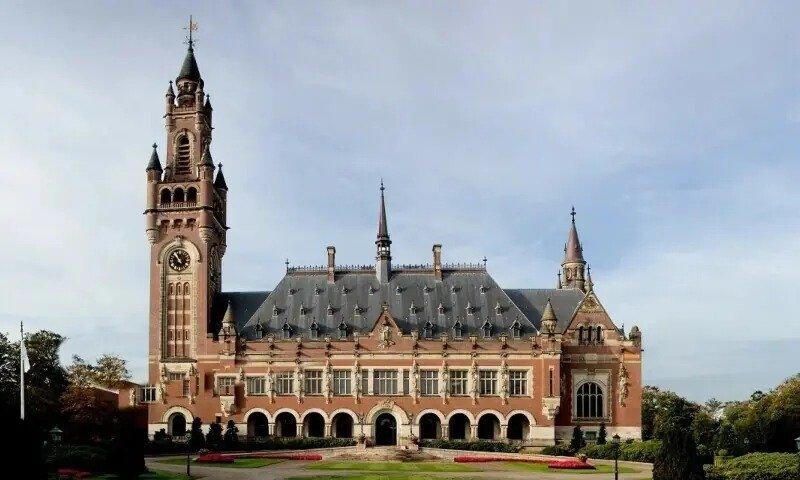
The Permanent Court of Arbitration (PCA) on Monday ordered India to uphold the Indus Waters Treaty (IWT) with Pakistan and suspend work on a hydro project in occupied Kashmir.
Water and the IWT continue to be a major dispute between India and Pakistan since India unilaterally suspended the treaty in April last year; a development that resulted in a temporary military showdown between the two nations in May 2025.
Upon India’s action, Pakistan declared that any attempt to suspend the water share was an “act of war,” considering the absence of any provision of such an act in the IWT. Pakistan subsequently contended that India violated the 1969 Vienna Convention on the Law of Treaties with such a unilateral suspension.
Through its order, PCA supported the Pakistani position, stating that the IWT between the two nations continued to be fully valid and India lacked any reason for terminating or suspending the agreement.
The Hague-based body made an award on the status of IWT “with regard to India’s decision on abeyance” and an order on Pakistan’s application dated March 4 on “interim measures” involving Ratle hydro-electric plant.
The PCA press release also stated that it “considered the grounds on which India could have suspended or terminated the Treaty, including the grounds set out by India in its public statements”.
“Unanimously, the court held that none of these grounds constituted a legal justification for suspending or terminating the Treaty.”
As a result, it ruled that the “Treaty is in full force and effect, and India is obliged to comply with its provisions, including those regarding the design and operation of its hydro-electric projects on the Western Rivers”.
Under the IWT, the eastern rivers — Ravi, Beas and Sutlej — have been allocated to India, whereas the western rivers — Indus, Jhelum and Chenab — belong mainly to Pakistan. The 1960 water-sharing accord has also set up arrangements for information exchange and dispute resolution.
Pakistan had asked the court to “address the design of certain components of the run-of-river hydro-electric projects that India has permission to build under the IWT on the Indus, Jhelum, and Chenab rivers and their tributaries (‘Western Rivers’) prior to the entry of these rivers into Pakistan,” read the PCA press release.
In the interim measures application, the court was asked to take up the cases of Kishenganga Hydro-Electric Plant (KHEP) and the Ratle Hydro-Electric Plant (RHEP).
Notably, the PCA observed that the Kishenganga and Ratle plants were “also the subject of proceedings” before a neutral expert appointed by the World Bank, who is due to make his final decision on whether they complied with the IWT in July 2027.
In its ruling, the PCA unanimously decided to “implement measures prohibiting India from concreting the RHEP dam wall and power intake structure above certain levels until 90 days after the issuance of the neutral expert’s final decision”.
In addition, the court adopted an interim measures reporting requirement relating to the RHEP Construction Schedule until shortly after the neutral expert’s final decision. It refused to impose two other measures sought by Pakistan.
The PCA also observed that “the Treaty does not provide for either party to terminate or suspend the operations of the Treaty, nor for ‘abeyance’”. The IWT states that it shall remain in force unless modified or terminated by India and Pakistan in conjunction through the adoption of another treaty.
The Court of Arbitration had been headed by Professor Sean D. Murphy of the United States of America. Others in the panel were Professor Wouter Buytaert of Belgium, Professor Jeffrey P. Minear of the United States, Judge Awn Shawkat Al-Khasawneh of Jordan, and Dr Donald Blackmore of Australia.
Pakistan appreciates findings
The Pakistani government “takes note” of the press release and “welcomes” the ruling of the PCA that India “remains bound by and must observe its obligations under” the IWT, according to the information ministry.
Pakistani officials also appreciated the court’s findings regarding the Ratle project, along with the actions the court took.
The government will “now be giving careful consideration to the detail of the award and decision, pending their publication, and how these may best assist in finding a pathway back to the parties’ engagement under the treaty,” it said.
The country, which is a formal member of the intergovernmental court, stated that it does not recognize the court and categorically rejects its ruling.
“Such so-called Court of Arbitration does not have any jurisdiction whatsoever in pronouncing on sovereign decisions of India,” the Ministry of Foreign Affairs of India declared in a statement.
Even though India did not take part in the proceeding by submitting its own views in either written or oral form regarding the application by Pakistan, “the PCA made an effort to take into account India’s views with respect to these issues, to the extent they could be determined based on statements and actions taken by India in other venues.”
India has no grounds to suspend IWT
The PCA looked at possible reasons for India to invoke an exception to the treaty, namely in customary international law, but concluded that there was “no rule allowing a state to unilaterally terminate or suspend the operation of a treaty based on its ‘sovereignty’,” according to the argument put forward by India.
A number of possible justifications for India’s actions in suspending the IWT were considered in light of India’s submissions, but the PCA found that none of them justified the suspension of the treaty by New Delhi.
Three of the “few, highly restricted grounds” on which a state could unilaterally terminate or suspend the operation of a treaty were identified – material breach of the agreement by a state party, the occurrence of fundamental change of circumstances and effect of armed conflict.
As to India’s claims regarding the violation by Pakistan of the cooperative spirit of the IWT through refusal to negotiate a modification of the treaty, the PCA concluded that there was “no provision of the treaty obliging Pakistan to enter into such discussion” and, therefore, “this can hardly be qualified as material breach of the IWT.”
Indeed, after looking into the correspondence between the two states, the PCA said that “it found that Pakistan had been willing to discuss with India the issue of treaty modifications.”
As regards India’s allegations of cross-border terrorism, which formed the basis of New Delhi’s unilateral decision to suspend the IWT, the PCA observed that “the treaty does not address terrorism or the use of force and expressly indicates that it governs only” the rights and obligations of parties regarding the Indus waters.
Furthermore, according to the PCA, “it did not find evidence that the alleged terrorism had impeded India’s ability to construct its HEPs on the western rivers and instead noted that India has built and is building many such HEPs, including in recent years.”
“Even assuming that India’s claim was found to be true, they still do not constitute a material breach of the treaty on the part of Pakistan,” it stated.
In respect to any fundamental change of circumstances, the court took into consideration “(1) demographic changes; (2) the need for clean energy in India; (3) changes in dam infrastructure technology; (4) increasing cross border terrorist attacks; and (5) impacts of climate change” argued by India.
However, in all these cases, the court found that the “necessary conditions for invoking a fundamental change of circumstances have not been satisfied under the law of treaties”.
The court noted that the “IWT is of a kind that can continue its operations” despite any kind of “armed conflicts”, which were absent at the moment.
Moreover, the PCA examined “whether India’s conduct can be justified as a countermeasure against an antecedent violation of international law by Pakistan”, but it was also found that the requirements of a legitimate countermeasure were not fulfilled.
The court held that the “termination or suspension of the operation of the treaty will affect India’s obligations to protect fundamental human rights, will not allow the resumption of India’s obligations under the treaty, and will prevent the application of the dispute resolution mechanisms of the treaty.”
Timeline of proceedings
According to the PCA press release, arbitration proceedings concerning the Western rivers had been initiated by Pakistan in August 2016.
However, in December of that same year, the World Bank opted to “pause” the process of appointing the chairman of the Court of Arbitration and the neutral expert. The pause was revoked in 2022, after which a neutral expert was appointed.
After India had unilaterally placed the IWT in abeyance in April 2025, the PCA assessed the impact of the action on the court’s competence in a “Supplemental Award on Competence” dated June 27 of that year.
The court argued that “India’s decision on the ‘abeyance’ of the treaty cannot limit the competence of the Court over this dispute”. “However, the court did not go further in determining whether the Indus Waters Treaty remained in force”, it added.
On March 4, Pakistan applied to the court for “determination of the present status of the Treaty in light of India’s decision on ‘abeyance’”.
India was invited to indicate whether it intended to take part in the proceedings; however, “no response was received”. Subsequently, the court ordered Pakistan “to file a written memorial further detailing its application and held a hearing at the Peace Palace in The Hague” from April 26 to 28.
A major test for a decades-old agreement
However, the Indus Waters Treaty has remained in place for more than 60 years, even amid numerous disputes and political crises.
The present legal battle is likely to be one of the most critical challenges faced by the Indus Waters Treaty.
The issue of water security has been getting more and more acute for both parties due to increasing population, demand for electricity, and climate pressure on the basin of the Indus.
Therefore, the ruling by the PCA affects the dispute over the Ratle project much more than just that project.
By stating that India could not terminate the treaty on its own and imposing some temporal limitations on certain building work, the PCA has emphasized the necessity of the legal framework regulating cooperation between countries concerning the use of the joint water resources.
The ruling does not eliminate political problems between Islamabad and New Delhi or resolve all the questions related to hydroelectric projects; however, it sets the legal precedent – the treaty is still in force and its obligations remain relevant.
For Pakistan, where the western rivers are essential for national security and food security, this ruling means a lot.
For India, the decision implies that it still has obligations under the treaty, whereas the separate legal and technical questions about the hydroelectric projects are discussed.
The next stage will be the decision made by the neutral expert regarding the Kishenganga and Ratle projects.
Before that decision, the ruling by the PCA can be treated as temporal legal boundary for Ratle construction.
