
The government on Monday raised the price of petrol by Rs0.77 per litre and cut that of high-speed diesel (HSD) by Rs1.03 per litre.
The revised prices will ensure that petrol is sold at Rs342.79 per litre and HSD will be priced at Rs370.41 per litre. The government still imposes Rs114 taxes and duties per litre on petrol and Rs100 per litre on diesel.
As per the notice issued by the Petroleum Division, these prices will come into effect from September 1 (Tuesday).
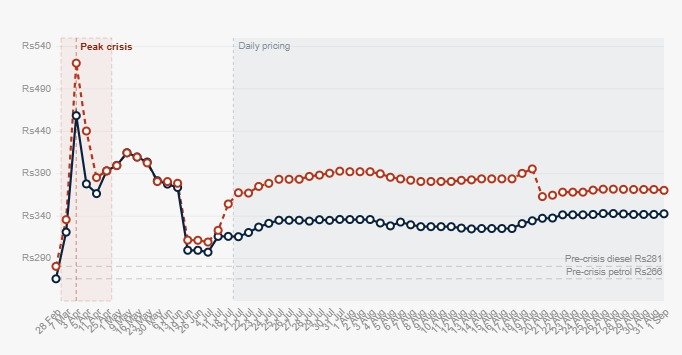
The HSD price has reduced from Rs520.35 which was highest on April 3. Its price had begun rising from Rs281 per litre since the breakout of US-Iran War on February 28.
The petrol price had hit Rs458.41 per litre on April 3 after its price began to rise from Rs266 per litre in the first week of March.
Previously, Petroleum Minister Ali Pervaiz Malik declared that fuel prices will now be set daily because of fluctuations in the prices of international markets on account of renewed hostilities between Iran and the US.
Since early March, the government has been revising the fuel prices on weekly basis along with some steps for saving fuel in wake of any disruption in oil supplies amid the ongoing conflict in the Middle East region.
As per the minister of petroleum, the cabinet and the prime minister have taken a decision to empower Ogra to decide prices of fuels on a daily basis according to international market trends.
Petrol is used extensively in private transportations, light vehicles, three wheelers, and two-wheelers, and its prices will influence middle and lower middle classes.
In a similar manner, changes in prices of diesel also affect the general public, because diesel is extensively used in heavy transports, power generation, and large generators.
Petrol and HSD contribute significantly towards the revenues of oil marketing companies. The monthly sales of petrol and HSD are approximately 700,000 to 800,000 tonnes, while sales of kerosene are only 10,000 tonnes per month.
Petrol price moves higher
The hike in petrol prices is being witnessed during a period where motorists are facing high costs of transport.
This fuel is extensively used by private car owners, motorbikes, rickshaws and small-sized commercial vehicles. Due to its extensive use in the process of commuting, any rise in its cost will be easily observed by the consumers.
As per the latest adjustment, consumers will pay Rs342.79 per liter of petrol starting from September 1st. Even if the rise is just 77 paisa per liter, it can become quite prominent for the consumers buying it regularly.
It may not seem like much extra expense for the consumers refilling their motorcycles. But for the individuals commuting through their cars and business owners running multiple petrol-operated vehicles, frequent hikes in petrol costs can add up.
Moreover, this rise in petrol prices can indirectly affect consumer prices. This is because the process of transportation is an integral part of the process of moving around the food, retail goods and other goods. Therefore, rising costs can result in increased operation costs for the businesses who might transfer some of these costs onto the consumers.
Therefore, this recent rise in the cost of petrol is moderate, and its further consequences will depend on future changes in international oil prices, exchange rates and national fuel policies.
Fuel prices remain far below their April peaks
The new prices are much lower than what was recorded earlier this year.
For instance, high-speed diesel attained an all-time high of Rs520.35 per liter on April 3. This sharp rise in prices occurred after it started from approximately Rs281 per liter when the tensions between US and Iran escalated on February 28.
This is one of the most volatile rises in the prices of domestically available fuels, causing many challenges to consumers and businesses.
Petrol also exhibited a similar trend. Its price rose to Rs458.41 per liter on April 3 from around Rs266 per liter in the first week of March.
These peaks compared to the current prices show the level of the turnaround experienced in the petroleum sector in the domestic market.
Currently, the price of petrol is at Rs342.79 per liter, which is much lower than its all-time high recorded in April. In the same way, the current price of HSD at Rs370.41 is also much lower than the peak price of Rs520.35 earlier in the year.
However, even after falling from all-time highs, these prices are quite high historically.
Taxes remain a major part of fuel prices
Another crucial aspect that influences the performance of Pakistan’s petroleum market is the total income earned by the government through taxation and duties.
Currently, there are Rs114 charged by the government in taxes and duties for each litre of petrol sold. As for high-speed diesel, the same amount comes to Rs100 per litre.
These fees make up a major part of the consumer cost.
Petroleum fuels are the main sources of revenues for the government. Petrol and diesel make up the vast majority of sales of domestic petroleum products, with kerosene being only a small part of sales.
The government’s capability to raise revenue from petroleum fuels makes fuel prices a part of the fiscal policy.
At the same time, excessive taxes on petroleum fuels increase the cost for the consumer, especially with international prices for oil rising.
It is a complex problem for the government as reducing tax will help to lower costs for consumers, but the budget will lose revenue during the current times.
Why petrol and diesel prices matter to the economy
Fuel prices go way beyond just petrol pumps.
There is no denying that petrol prices directly affect millions of users of motorcycles, cars, rickshaws, and other forms of transport. In most cases, the transportation sector constitutes a huge cost burden for many families where people regularly have to travel in their jobs and schools.
Diesel has an even more crucial economic function since it is largely tied to commercial transportation and manufacturing.
Trucks that ferry agricultural produce from rural areas to urban markets use diesel. Passenger buses that move across cities and provinces use diesel. Construction equipment, agricultural equipment and generators also use diesel fuel.
Therefore, changes in prices of HSD will affect the cost structures of many industries.
Decrease in diesel prices will reduce transportation costs although other factors such as labor, road, and maintenance costs will ultimately determine the end result for consumers. The Rs1.03 decrease this time around is relatively small although it may have a limited effect on general inflation.
Petroleum products are major revenue earners
Petrol and high-speed diesel continue to be the most significant petroleum products of the country in terms of sales quantity.
The monthly sale of petrol and HSD stands at approximately 700,000 – 800,000 tons, while the monthly requirement of kerosene stands at only 10,000 tons.
Such huge differences are behind the reason why the government pays so much heed to the pricing of petrol and diesel.
As both products are consumed in large quantities, the small difference in taxes or prices may create big effects in terms of revenue generation and consumer spending.
From the point of view of the government, it needs to earn a regular income from the petroleum business; on the other hand, from the consumer’s perspective, the same becomes an additional expense at the fuel pump.
What consumers can expect next
The new petroleum prices will take effect from September 1, 2022, with petrol costing Rs342.79 per litre, while HSD will cost Rs370.41.
In determining the future price trends, a major determinant will be the price levels in international oil markets and geopolitical conditions in the region.
Where international crude prices are stable or falling, there is scope for lower petroleum prices. However, an upturn in international oil prices may put pressure on domestic prices.
Changes in currency values will also continue to matter since Pakistan has to rely on imports to meet most of its petroleum requirements. While international oil prices are stable, depreciation of the local currency can cause an increase in local oil prices.
Government policy in regard to taxes and duties is another major determinant of future prices, as petroleum taxes and duties can go up or down.
For now, drivers have to contend with higher petrol prices but reduced diesel prices.
A mixed outcome for consumers
The latest petroleum price revision has brought with it an interesting scenario for Pakistani consumers.
The increase of Rs0.77 has been observed in petrol prices per litre, while the decrease of Rs1.03 has been recorded in high speed diesel prices per litre.
Both revisions have not been significant enough individually to bring any kind of drastic change in consumer spending and businesses’ expenditures. Yet, there is a multiplier effect associated with fuel prices that makes both the revisions highly relevant for the consumers and businessmen.
What is more important is that current prices are much below the unprecedented highs witnessed in April, when the price of petrol had risen up to Rs458.41 per litre and high speed diesel to Rs520.35 per litre.
This considerable fall in price has brought relief against the rise in prices which was due to international oil price hikes.
Pakistan’s fuel prices, however, depend upon external factors as well and thus remain subject to the influence of such things as the situation in Middle East, the price of crude oil, exchange rate changes and government tax policy.
At this point in time, with the new prices becoming effective from September 1, petrol prices would be Rs342.79 per litre while high speed diesel would be priced at Rs370.41 per litre.
The government would keep monitoring international market situation for setting the petroleum prices in the coming periods.
One of the questions that many Pakistanis ask themselves now is whether these prices will stay low or will rise because of the external pressures.
