
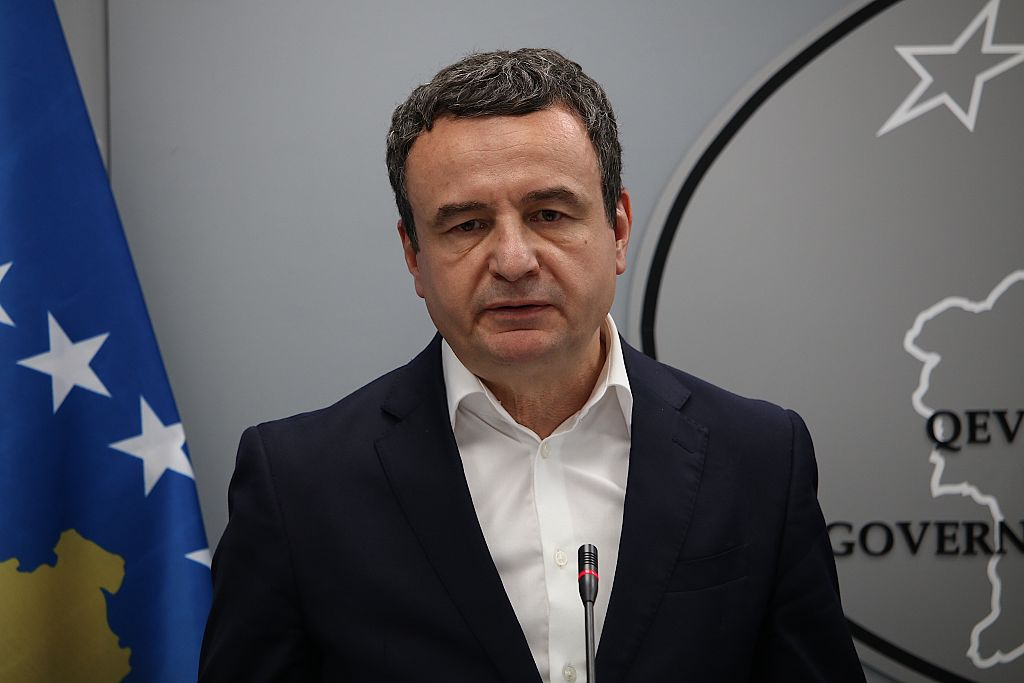
PRISTINA, August 10, 2026 — The political crisis in Kosovo took an unpredictable twist following the throwing of eggs by an opposition parliamentarian at the country’s caretaker Prime Minister, Albin Kurti, during a heated parliamentary session.
The act happened yesterday when the parliament gathered to talk about the political deadlock faced by the country. The opposition Member of Parliament (MP) Time Kadrijaj, who belongs to the Alliance for the Future of Kosovo, hurled eggs at the caretaker prime minister when he requested more time to negotiate with political parties.
The opposition member also yelled at the caretaker prime minister during the attack. While the parliamentary security tried to guard the prime minister, the session was put on hold, and the live broadcast ended.
This bizarre episode demonstrated the increasing frustration among opposition parliamentarians amid Kosovo’s attempt to sort out its political stalemate that might ultimately result in a new parliamentary election.
Political Impasse Persists
Following parliamentary elections held in June, Kosovo remains in a protracted period of political uncertainty. While Kurti’s Vetëvendosje party proved to be the most powerful political player, it lacks enough representation in order to form a government on its own.
The Vetëvendosje secured 53 seats in the 120-seat parliament, thus falling short of eight seats from the required number of 61 in order to achieve a majority. The Democratic Party of Kosovo got 22 seats, while the Democratic League of Kosovo got 18.
Unable to secure sufficient support from other parties, Kurti has to hold negotiations with the opposition parties in order to restore proper working institutions.
The aforementioned talks have not led to any concrete results yet.
The most recent controversy revolves around the election of a new president, as according to Kurti, consultations with political parties are still going on and he needs additional time to come to an agreement.
The said request has been met with hostility by members of the opposition party, which finds the political process to be too delayed.
Kurti Insists That Dialogue Should Be Continued
Regardless of the altercation that took place in parliament, Kurti remained quite unperturbed about the egg-throwing attack.
The interim prime minister revealed that he is prepared to put up with such confrontations if it would enable political dialogue to take place and allow for the resolution of the crisis.
The view expressed above is a reflection of the dilemma faced by the government. Kurti needs to gain political support without having a repeat election to further prolong the crisis.
But in the case of the opposition, patience seems to be wearing thin.
The opposition members of parliament have accused the ruling party of not making enough headway on the issue.
Risk of Re-Election
With the situation remaining deadlocked, the risk of holding another election has emerged.
A re-election will be an additional source of political uncertainty for a country that has been already affected by political tensions. One of the youngest democracies of Europe, Kosovo has faced several political confrontations in the past few years. Disagreements on the issue of government formation and appointments of officials often become barriers to efficient governance in Kosovo.
Therefore, the current conflict in the parliament of Kosovo is more than just a political drama; it is a concrete manifestation of frustration with the political system of the country.
Should political parties fail to come up with a decision, holding another election will become increasingly likely.
At the same time, another election will not automatically mean finding a solution to the existing problems. Differences between political parties can persist even after the elections.
Pressure on Political Leaders in Kosovo
This is a challenging moment for Kosovo. It is crucial for stable institutions to be able to resolve all problems and preserve good relations with all international partners.
In addition, Kosovo is trying to make some progress in its European aspirations, thus political stability plays a huge role in its international policy.
These images showed clearly how much relations between the ruling coalition and the opposition have been strained. An argument about negotiations and procedures in the parliament turned into an extremely rare conflict that stopped all activities of the parliament.
It is necessary for political leaders to work out a way to bring things back to normal and find the constitutional solution of this institutional problem.
In the case of Kurti, he should be able to convince political parties to join in the process of choosing a new president and forming institutions.
On the other hand, the task of opposition is to put pressure on the caretaker government and decide if negotiations or new elections are the best choice.
A Sign of a Bigger Crisis
While the egg throwing might have captured all the attention due to its spectacular character, the problem at hand is far from being trivial.
Kosovo continues to lack any form of political compromise that would put an end to the existing deadlock. The conflict that erupted in the parliament was nothing other than a vivid demonstration of how tough the negotiations became and how fast political frustration could escalate to chaos.
The next few weeks will probably turn out to be quite decisive. Should the political parties manage to agree, Kosovo would be able to avoid the new elections and start rebuilding its political institutions.
Otherwise, the people of Kosovo might once again be called to the polls.
Until then, the suspended session of the parliament is a clear indication of the ongoing political crisis. What is important now is not to win any political disputes but to find sufficient common ground for the functioning of the country’s institutions.
