
The US government has labelled Palestine Action, which is a militant group based out of the UK, as a ‘specially designated global terrorist’ group, marking yet another escalation in the anti-militant policies of Washington towards those groups whom it considers to be funding political violence and terrorism.
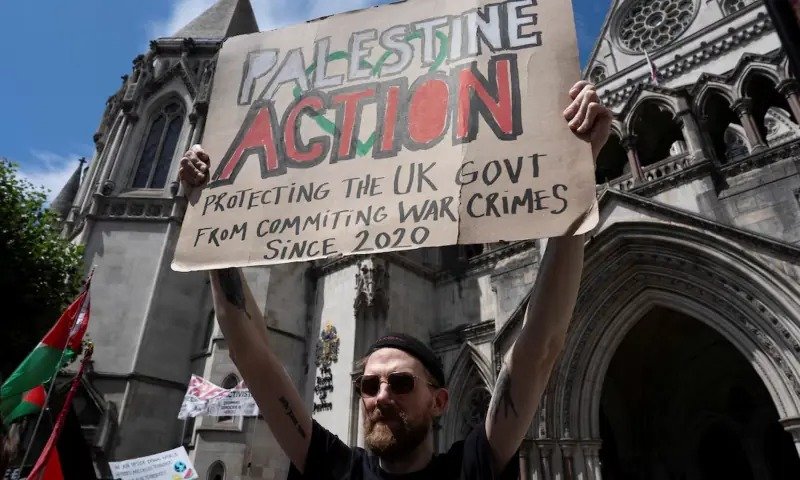
The labelling of Palestine Action, which was announced by the US government on Wednesday, comes along with sanctions imposed on the group and the group being put in the same category as two other groups that have been singled out in the recent sanctions regime. This has come as a result of the ban imposed on Palestine Action by the British government earlier this year, and which has sparked off much debate regarding civil liberties and political activism.
Palestine Action has rejected all charges of terrorism levied against it and said that its activities are aimed at disrupting Britain’s participation in Israeli military operations in Gaza.
US imposes sanctions on Palestine Action
The US State Department designated Palestine Action as a terrorist organisation on account of an “act of terrorism” in support of which Washington said it was being designated as a terrorist organisation.
US officials also described Palestine Action, alongside two other groups designated on Wednesday, as violent “far-left terrorist groups”.
The designation was made by the US Treasury Department, indicating that Washington is planning to employ its economic and legal means to limit the financial access to the organisations.
Scott Bessent, the US Treasury Secretary, declared that the United States will employ the economic might to go against political violence.
“Political terrorism has no place in our society,” said Scott Bessent while adding that Washington would go ahead in trying to eliminate the financial means of existence of the organisations.
This has been seen as a significant step taken by Washington against the organisation, Palestine Action. However, depending on the implementation of the sanctions imposed by the US and the relevant laws, it could also affect the persons or organisations which help financially or otherwise.
The move has come after President Trump, during his second term in office, has started focussing upon the far left organisations and movements.
What is Palestine Action?
Palestine Action is an organisation that was formed in the United Kingdom in 2020 and is known for running direct action campaigns against companies involved in supporting the defence industry of Israel.
The group has targeted the Elbit Systems, the biggest Israeli defence firm, which runs facilities and conducts business in Britain.
In addition to protesting and organising other direct actions at the firms’ premises, Palestine Action aims at causing disruptions and drawing attention to Britain’s relationship with the defence industry of Israel.
Palestine Action claims that its campaign is aimed at bringing an end to what it regards as Britain’s involvement in Israel’s military operations. The organisation declares its aim of bringing an end to “global participation in Israel’s genocidal and apartheid regime” on its website.
The group’s activities have drawn a lot more international attention following the Hamas-led attack on southern Israel and the resulting military operation conducted by Israel in Gaza on October 7, 2023.
The war has resulted in numerous protests around the globe, and in Britain, protesters have continuously organised actions and campaigns targeting Britain’s political, military and economic relations with Israel.
Palestine Action has framed its direct action approach within the campaign to pressurise defence firms and governments on their relation with Israel.
Britain’s ban sparked controversy
The US ruling is an outcome of the British government’s banning of Palestine Action on grounds of anti-terrorism laws.
The banning by the British government is now arguably the most controversial element of the government’s approach to the organisation.
In the aftermath of the banning, joining Palestine Action, expressing public support for the organisation, and some activities connected with the organisation are subjected to criminalisation in Britain.
It is estimated that thousands of people were arrested in Britain because of protesting against the ban and the organization.
Government supporters claim that such restrictions are needed because of the vandalistic acts carried out by Palestine Action and the disruption they caused. The critics of the government, however, claim that such a step is excessive and may lead to criminalising peaceful political activism.
Human rights organizations criticize the banning, claiming that the government needs to make a difference between violent criminal behavior and legal protest.
This ban has also initiated the discussion about using the anti-terrorism laws for prosecuting the activists.
The organisation is challenging the British government’s decision to ban them.
Palestine Action rejects US accusations
The US description of the group as a terrorist organization has been dismissed by Palestine Action.
According to Huda Ammori, one of the founders of Palestine Action, the activities carried out by the group have targeted disruption of the military industry of Israel but not civilian targets.
In her interview to Reuters news agency, Ammori asserted that the decision of the US was an illustration of the international consequences of the ban in Britain.
“Ammori says the campaign is about “saving lives by disrupting the Israeli war machine”.” She added that such decisions can have far-reaching consequences in terms of freedom of speech.
These statements are a clear reflection of the main message conveyed by Palestine Action and its supporters: that activism targeting defense facilities is considered to be a form of political activism, not terrorism.
The point of view of the American and British authorities is absolutely different as they emphasize the methods of activism and disruptions caused by activists.
Two other groups targeted by Washington
Palestine Action was not the sole group subject to sanctioning actions in Wednesday’s American moves.
Washington also listed Italy-based Autistici/Inventati – better known as A/I Collective – as a terrorist group.
Masar Badil, a transnational group that is reportedly serving as a front for the Popular Front for the Liberation of Palestine (PFLP) in Washington’s view, was subject to sanctions by the US Treasury Department separately.
The PFLP itself has previously been labeled as a Foreign Terrorist Organisation (FTO) by the United States.
The use of sanctions and terrorist designations by American officials has been increasing lately as a means to curb fundraising and activities of these groups and individuals abroad.
Wider debate over political activism
It has sparked a wider discussion concerning the way governments deal with political organizations which make use of direct actions.
Activists often claim that demonstrations, occupations and civil disobedience are needed in cases where other political measures prove ineffective in creating a change. At the same time, governments must ensure the safety of citizens and protect their property and other important facilities.
The conflict appears to become especially challenging when it comes to destructive or obstructive activities in the course of protests.
Palestine Action specifically chooses defence firms because disruption is deemed justified due to the firm’s involvement in Israel’s military operations.
Critics of the organization suggest that any kind of crime or illegal actions cannot be considered acceptable under the pretext of achieving a political goal.
As far as the U.S. decision goes, it poses a wider question about the relationship between national security measures and activism.
Impact on civil liberties
There have been fears from rights groups over the possible impact of the British ban on freedom of expression.
The critics have raised the issue that using the anti-terrorism laws on such organizations might have a chilling effect whereby people would hesitate from attending rallies, donating towards political campaigns and also voicing their political opinions because of fear of punishment or financial repercussions.
Those advocating for stringent measures on the other hand believe that governments should take a firm stand in case of activists engaging in any acts of violence or criminality.
The difficult thing for the governments would be in trying to differentiate between political activism and unlawful or violent activities.
This is becoming a significant problem in connection with the war in Gaza since there have been rallies being held in support of the Palestinians throughout Europe, North America and other parts of the world amid the heated debate on Israel’s military action and the policies of the Western countries towards this situation.
What the designation could mean
It would certainly pose a significant hurdle for Palestine Action and its supporters in accessing any international financial services that involve the US.
Sanctions from the US can impact financial institutions and people who do business with the listed organizations. This may be so since even organizations not based in the US may experience problems in their financial transactions because of the importance of the US financial system in international transactions.
This action could also make it necessary for foreign governments and institutions to examine transactions with Palestine Action.
Nevertheless, it is difficult to predict what consequences there might be, depending on the breadth of sanctions imposed by the US and how they are implemented.
For Palestine Action, this action comes on top of an already existing legal struggle in Britain.
A growing international dispute
The move by the US highlights how the problem of Gaza has become increasingly entangled with domestic politics and law enforcement not only in the Middle East but throughout other parts of the world.
There are conflicting pressures being brought to bear on governments: one group calls for harsher treatment of Israel and organizations associated with the defence industry of Israel while the other calls for tougher stance against organizations suspected of supporting violence.
The ban on Palestine Action by Britain followed by the move from the US to designate the organization highlight how governments are using increasingly harsh laws in tackling this problem.
For supporters of Palestine Action, these measures constitute an attack on protest groups and civil liberties. For the US and British governments, however, the problem lies in security and maintaining public order.
It is clear that the dispute will continue for some time.
Palestine Action remains defiant to the ban by Britain and the move by the US may increase the pressure on it.
Conclusion
US designation of Palestine Action is a landmark event for the ongoing international dispute regarding the activities of the group and a larger discussion surrounding pro-Palestinian activism.
Founded in 2020, Palestine Action gained popularity through direct-action protests targeting Israeli defense contractors in Britain, notably Elbit Systems. The group claims that its goals include disruption of supply chains and the disruption of British-Israeli cooperation.
The British government, however, has adopted a drastically different stance, banning the group using terrorism-related legislation. As a result of the ban, arrests took place and the actions were criticized by human rights activists for violating the right to free speech and assembly.
The US administration’s move brings the dispute to the other side of the Atlantic.
Through the designation of Palestine Action along with Autistici/Inventati, as well as the sanctioning of Masar Badil, the Trump administration has clearly demonstrated its desire to target the groups which it associates with the violent far-left movement.
The essence of the controversy, therefore, boils down to an extremely challenging question – how to strike the balance between national security and public safety on the one hand, and the right to protest politically on the other hand.
It is hard to expect that the answer will emerge anytime soon due to pending legal cases, protests, and discussions.
